Samuel, Saul, David, and Solomon

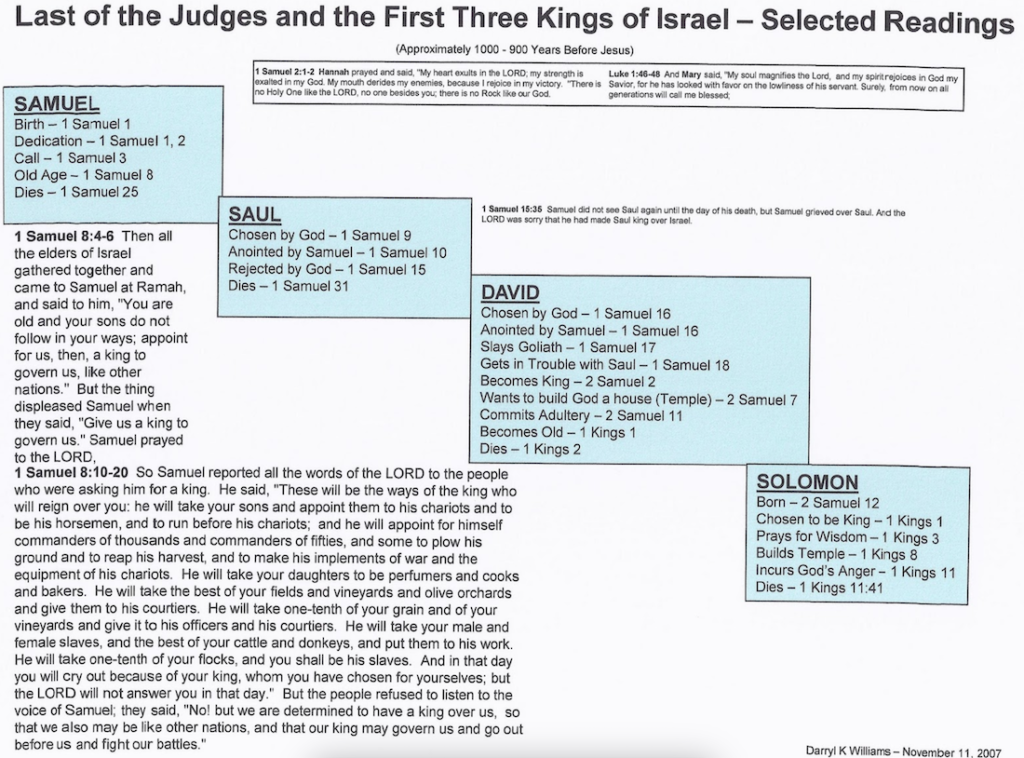
Everybody who grew up going to Sunday School in a Christian church knows the stories of the boy Samuel being called by God three times but thinking the calls were from the priest Eli, of Saul being anointed by Samuel as the first king of Israel, of David slaying Goliath, and of Solomon solving a dispute over a child by ordering that the child be cut in half with each claimant getting a portion. But those offer just a glimpse of the richness that can be found in the Old Testament accounts of the lives and deaths of these important leaders.

Samuel was the last of the judges of Israel because his sons were not seen as suitable successors and the people were demanding a king. After all, everybody else had a king. Samuel’s warning to the people of what a king would do resonates today as we see kings still failing and falling around the world. His words might even serve as an advance warning to us as we tend to look to presidential candidates as all-powerful solutions to all our problems. Are we looking for a king or a savior?

The mysterious encounter between Samuel and Saul whom he anoints as the first king and whom he helps find some missing donkeys, ending with Saul in a “prophetic frenzy,” is not typical Bible story material. The X rated encounter of David and Bathsheba, ending in the murder of Bathsheba’s husband, is as racy as modern TV shows and movies. And, we don’t spend a lot of time talking about God’s anger with Solomon, led astray by his seven hundred princesses and 300 concubines, and Solomon’s final failure as a King.

The outline below highlights key points of the stories of these four leading characters in Jewish and Christian history. Read and enjoy. Pay special attention to the story of Samuel’s mother, Hannah, and Samuel’s birth and upbringing. There are interesting parallels between Hannah’s prayer in 1 Samuel 2 and the prayer of Mary the mother of Jesus in Luke 1.  Click on it for a high-resolution view.


Note: This is another in a series of Old Testament story outlines that were developed for and used in a confirmation class for middle school students. Earlier outlines posted are these:

Primeval History in the Bible

Three Patriarchs, Three Matriarchs, and a Favorite Son

Moses, Miriam, Aaron, and Joshua

Israel’s Judges

Israel’s Judges

There is that old Bible trivia question: Who in the Bible (besides Adam and Eve, of course) had no parents?  Why, Joshua, the son of Nun, of course.  Joshua took over from Moses and led the people in some degree of conquest of the Promised Land. Then Joshua died, and things got pretty messy with no powerful leader in charge. According to the book of Judges, The LORD raised up Judges who seem to have been tribal and military leaders. Twelve are mentioned, but the best known are Deborah, Gideon, and Samson. Their’s are provocative and interesting stories including an incident of a tent peg driven through somebody’s head, an army thinned down to only a few good men, and the first known suicide pillar puller. This period of the judges last about 200 years and was a time when “all the people did what was right in their own eyes.” You’d think that would have made them happy.  


Moses, Miriam, Aaron, and Joshua

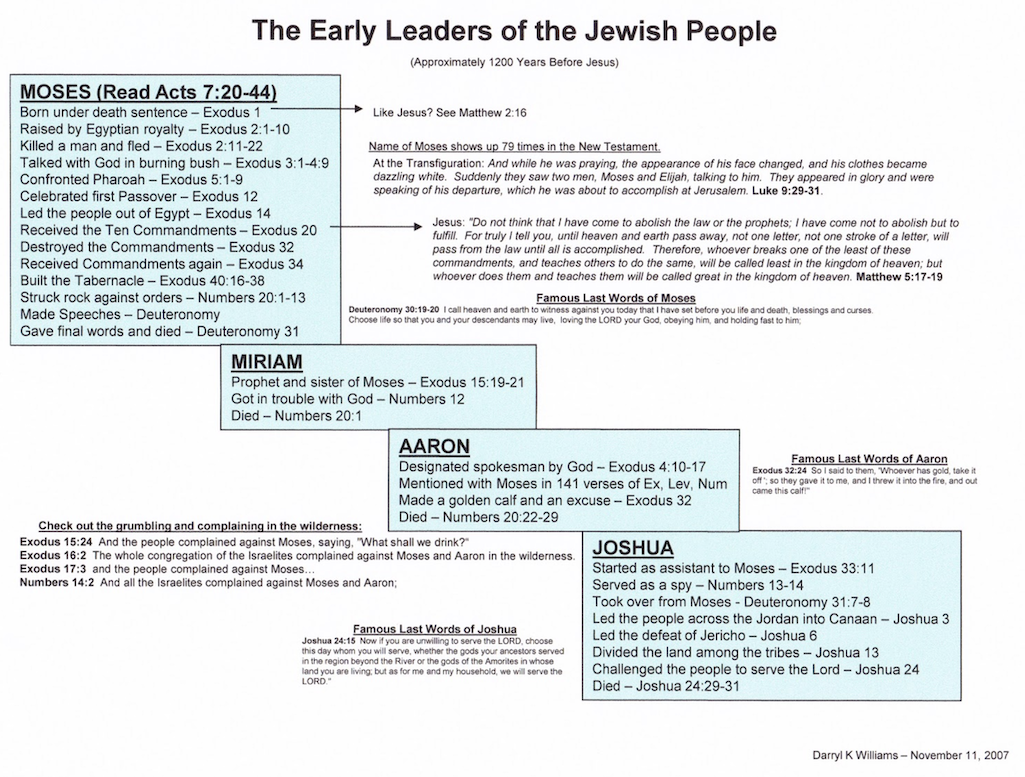
Moses, his prophetess sister Miriam, his spokesman Aaron, and his successor Joshua are the dominant characters of the Old Testament books of Exodus through Joshua. Abraham had just gotten up and gone when God told him to do so, but Moses started a new tradition by explaining why God had made a bad choice and why His plan might not work. Finally he was persuaded and rose to the occasion by leading the people out of Egyptian slavery and dealing with their complaints in the wilderness for forty years.

The name of Moses, an important character in Christian tradition, shows up 79 times in the New Testament, and he appears with Jesus and Elijah on the Mount of Transfiguration. He did a lot of preaching near the end, advising the people to “choose life,” and died at age 120, “his eye undimmed, his vigour unimpaired.” Not a bad way to go.

Miriam is famous for leading all the women in a song of praise to God after their escape from Egypt and for angering God by criticizing Moses, “the humblest man on earth,” over his choice of a mate. Aaron was an able staff assistant to Moses but set a new standard for blame dodging with his statement that he had collected gold from the people and thrown it in the fire “and out came this calf!

Joshua started as an assistant to Moses, did some spying in the Promised Land, and then took over leadership when Moses was denied the joy of leading the people across the Jordan River. He is best known for that battle at Jericho. A famous and oft-quoted phrase from Joshua is, “…for me and my household, we will serve the Lord.”

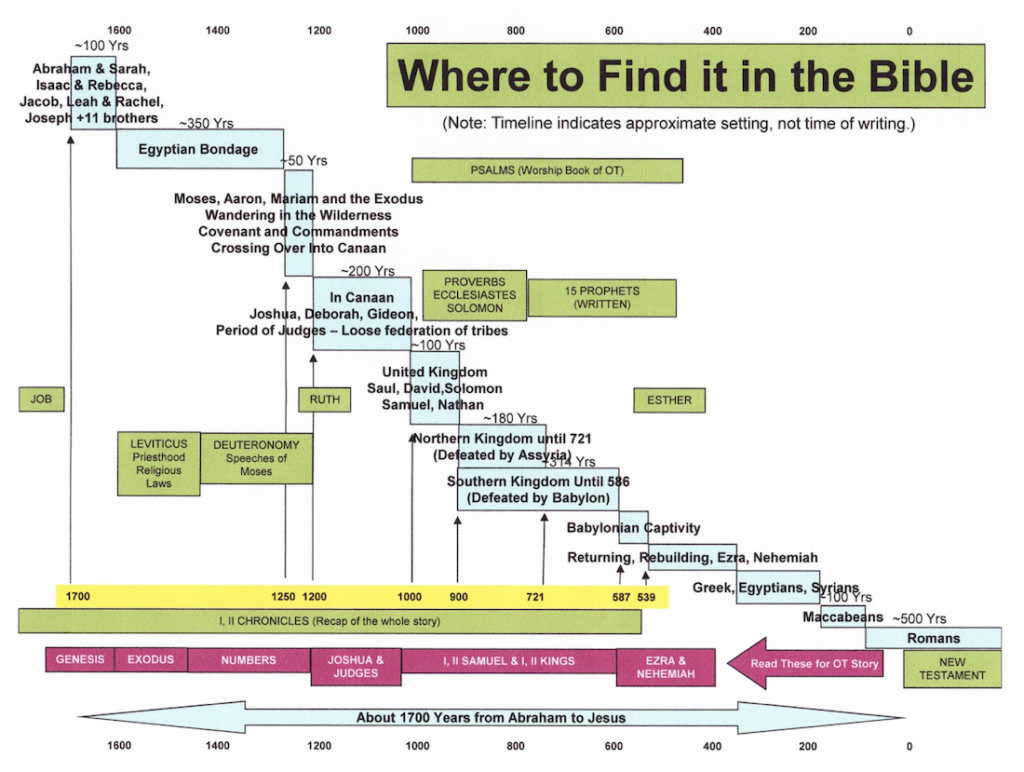
The stories of these people are entertaining, sobering, and inspiring. The exhibit below outlines the major events and tells where to find them in the Bible.  


Three Patriarchs, Three Matriarchs, and a Favorite Son

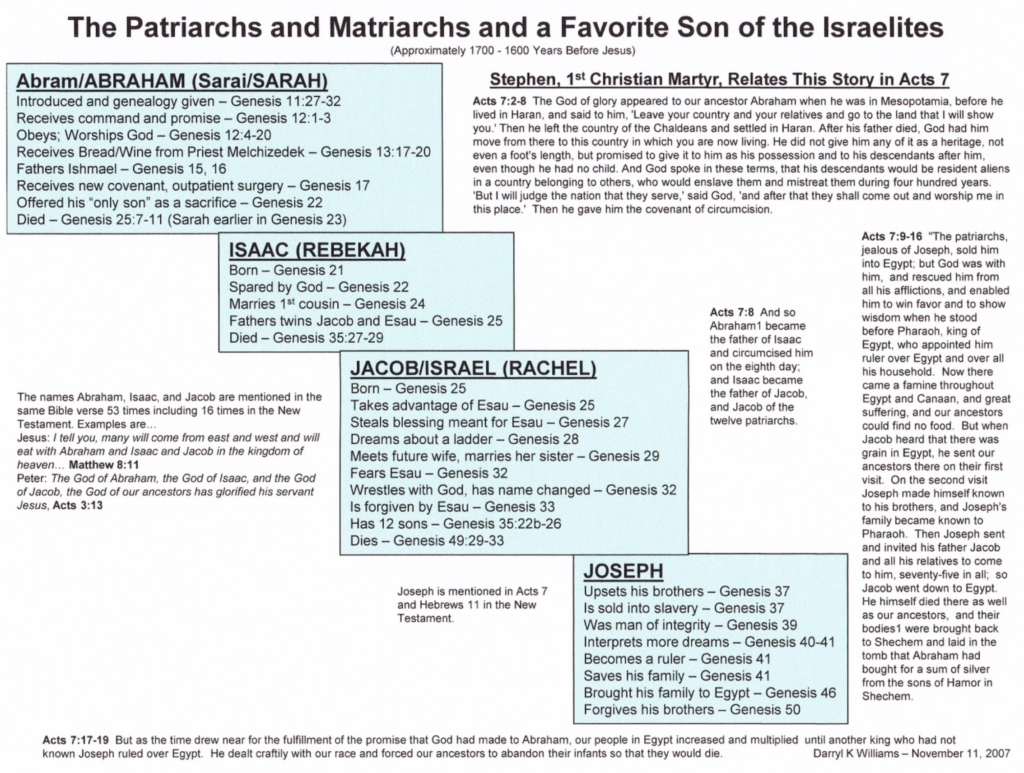
Once Abraham shows up at the end of Genesis 11, the rest of the 50 chapters cover his life and the lives of the other patriarchs and matriarchs of the Jewish people including his wife Sarah, their son Isaac and his wife Rebecca, and their troublesome twins, Jacob and Esau. Jacob, with minimal and non-exclusive help from his wife Rachel, fathers the twelve heads of the tribes of Israel including Joseph whose story occupies the last 16 chapters. It’s a great story, recounted briefly by Stephen, the first Christian martyr, in Acts 7 just before being killed by stoning.

The exhibit below is a guide to reading and remembering the stories with references given for major events in the lives of all these chosen people. They are worth remembering because six times in the New Testament, God is described as the God of Abraham, Isaac, and Jacob, and we are told by Jesus in Matthew 8:11 that “…many will come from east and west and sit down with Abraham and Isaac and Jacob at the feast in the kingdom of Heaven.”

This story ends with favorite son Joseph in a position of prominence and authority in Egypt when “there came to power in Egypt a new king who had never heard of Joseph.” (Exodus 1:8)  That is a preface to drama.


Primeval History in the Bible

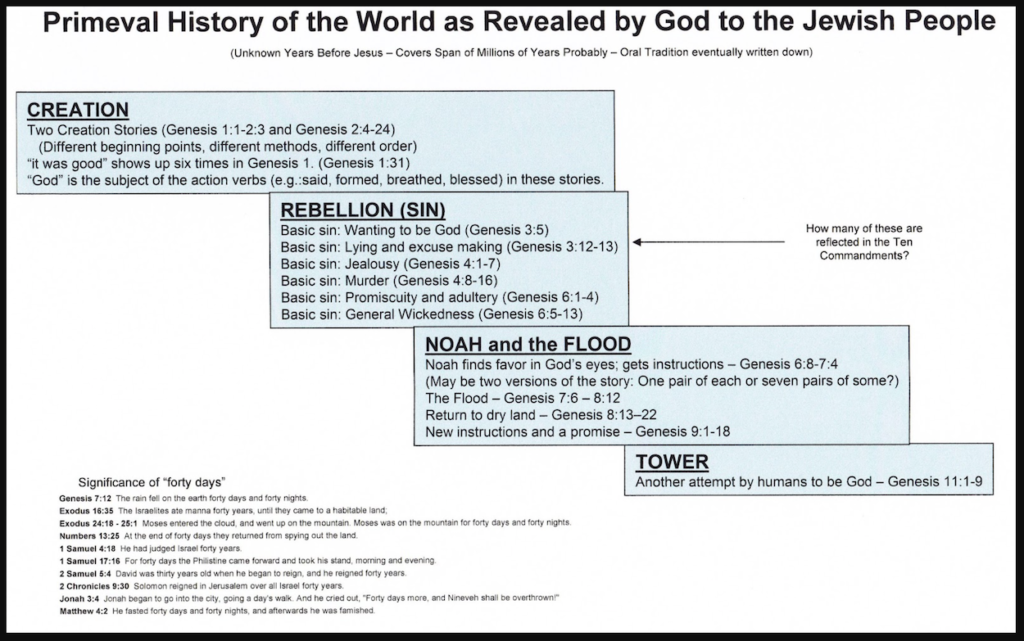
Here is a brief and possibly helpful outline of the four major Biblical events in primeval or ancient or prehistorical times covered in the first eleven chapters of Genesis. Whether these stories are taken as literal truth as some fundamentalist Christians do or as revelation of eternal truths told and eventually written in the genre of myth, the focus must be on what they teach about God and humankind.
 
An interesting feature is the first mention of “forty days” as a significant period of time.That is how long the flooding rain lasted in Genesis, it is how long Jesus was tempted in the wilderness, and the tradition survives in the Church today in the forty days of Lent. Some other examples are listed on the exhibit below. There is an interesting summary of Biblical uses and significance of that time period at the Catholic Culture website.


Prophets Prophets Prophets

 
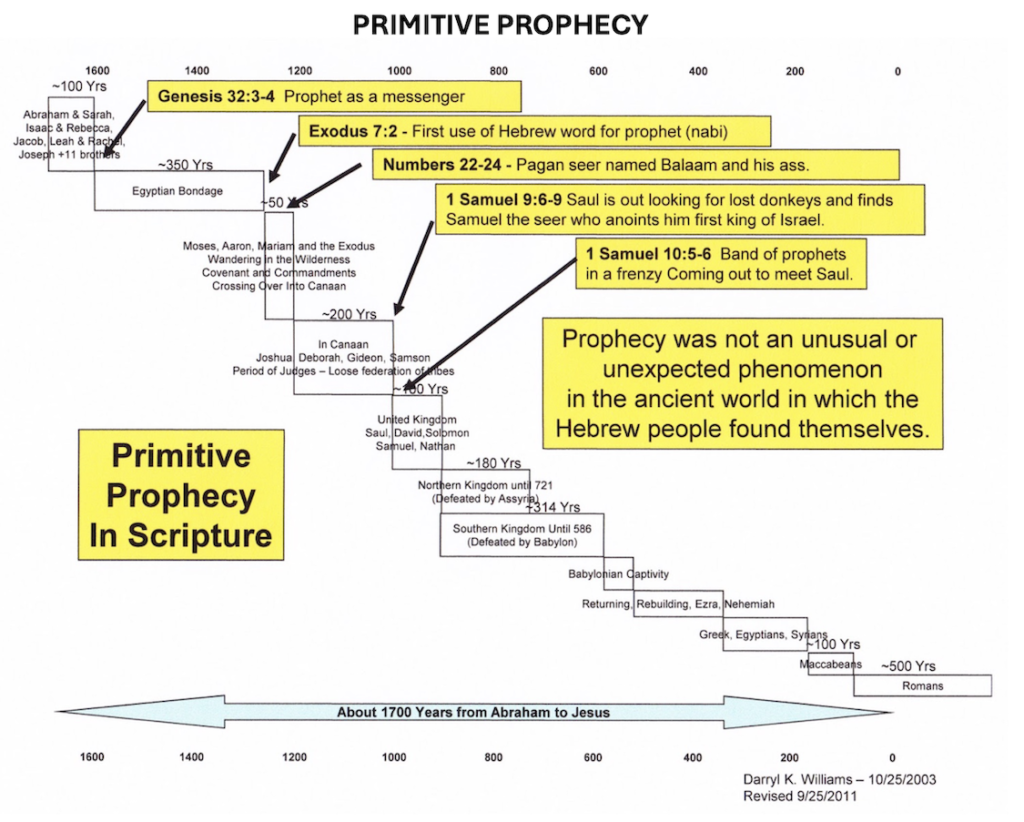
In the fall of 2003 I took Dr. Lamontte Luker’s course in Old Testament Theology at Lutheran Theological Southern Seminary.  A good portion of that course was on the thread of prophecy that runs from the first hint of messengers as prophets in Genesis 32 and first use of the Hebrew word for prophet, nabi, in Exodus 7 through Malachi, the last of the classical prophets.
 
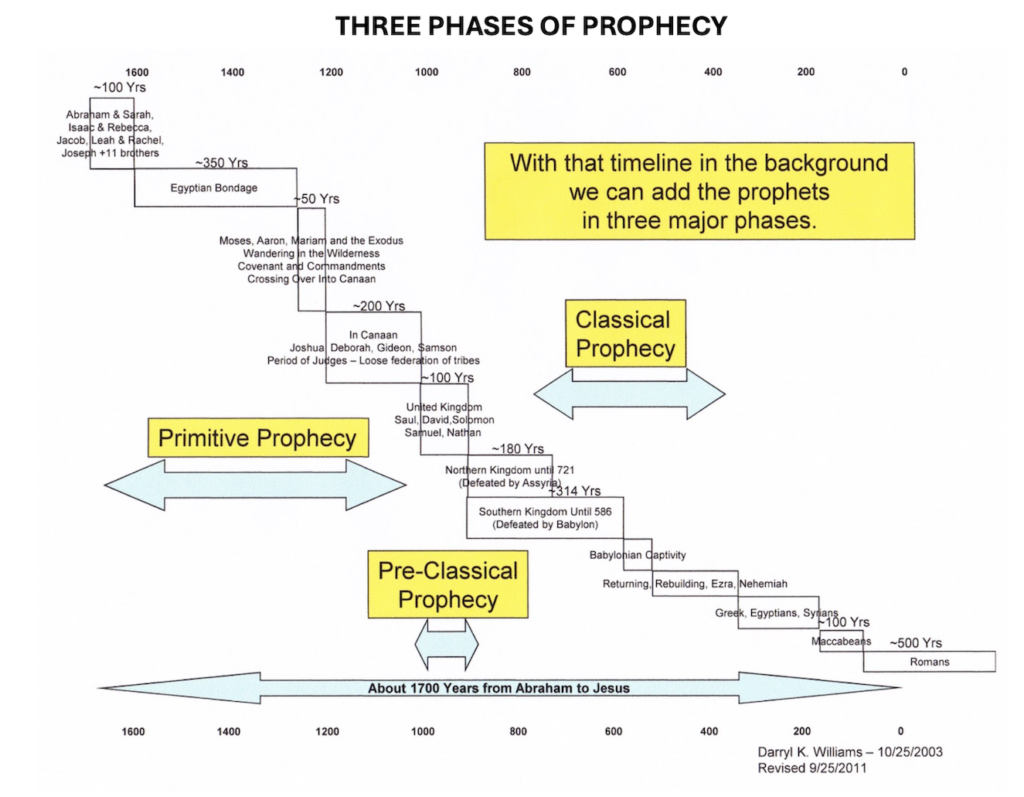
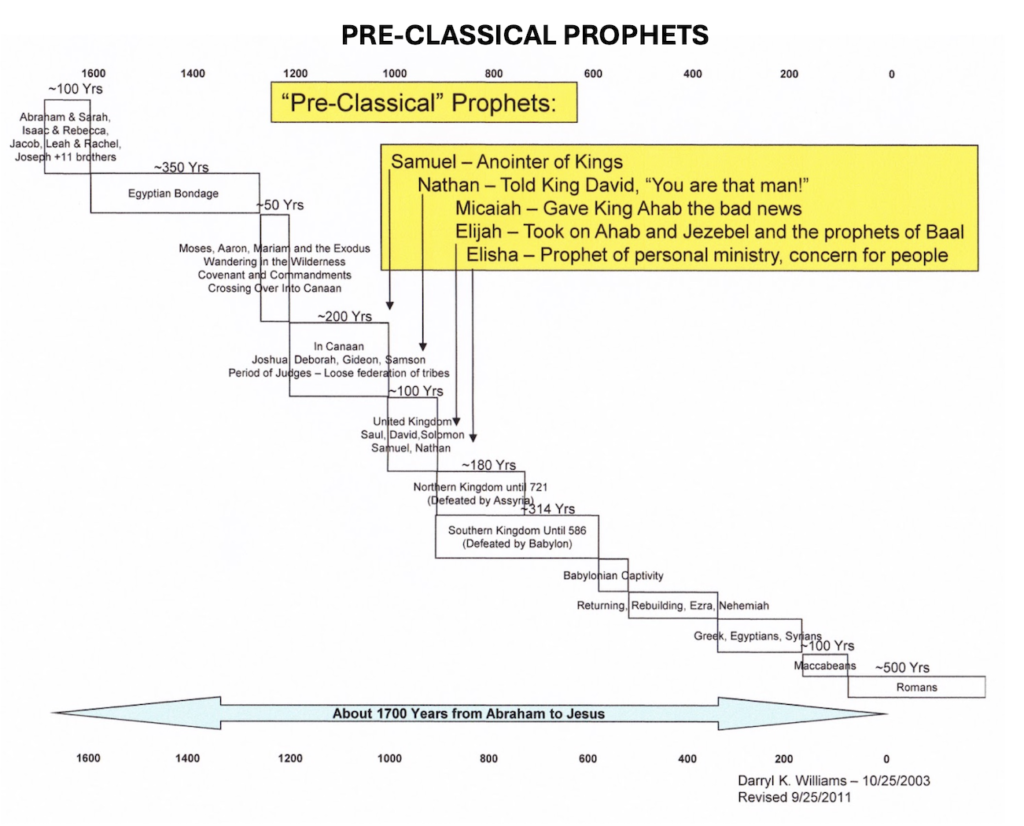
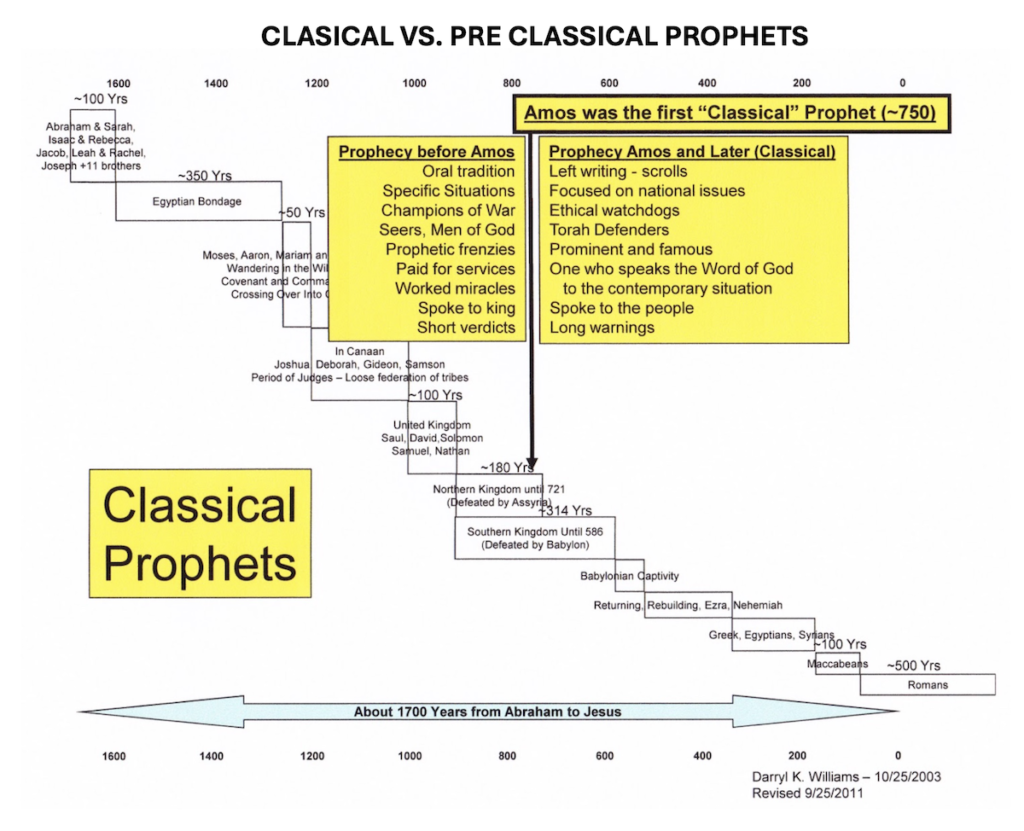
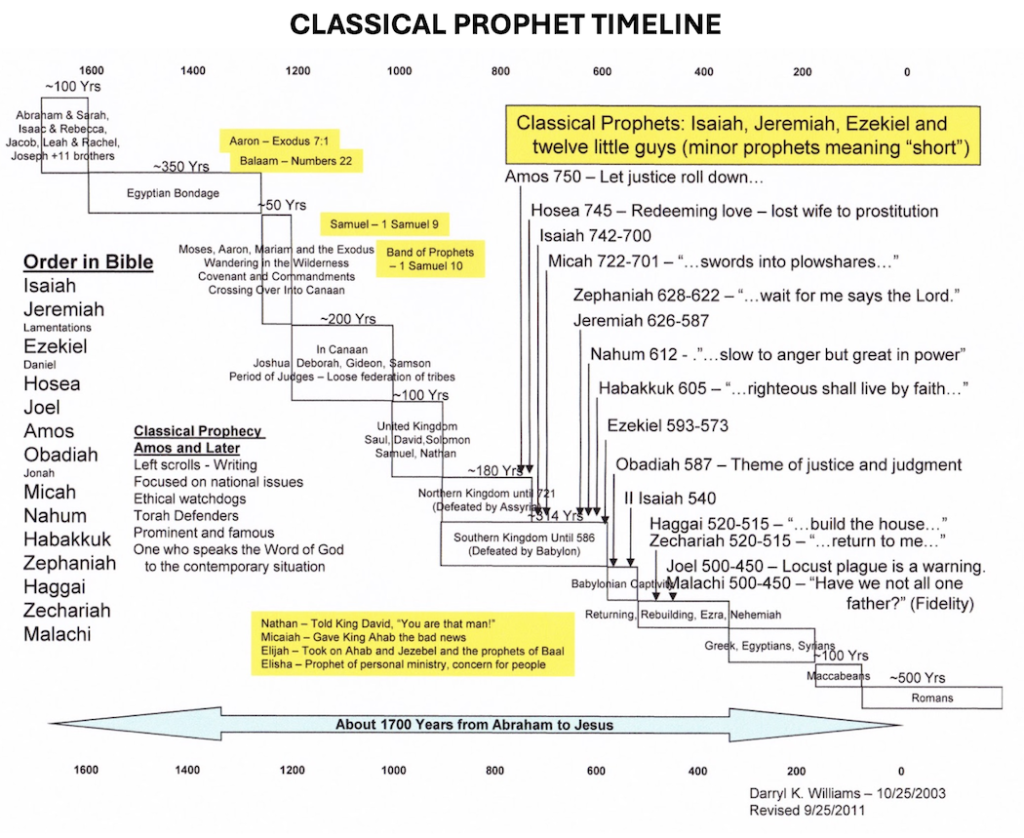
I have commented earlier on my difficulty remembering details and the need to outline and present information in some way that makes it visually interesting.  The charts below were created to help me remember key points about the history of prophecy and about the prophets themselves.  As I have also said, most of the value of such exhibits is in the creation of them rather than in the use of them by others, but they took a fair amount of work and I hate to just toss them out.  They are not worth much now, but at least they are free.
 
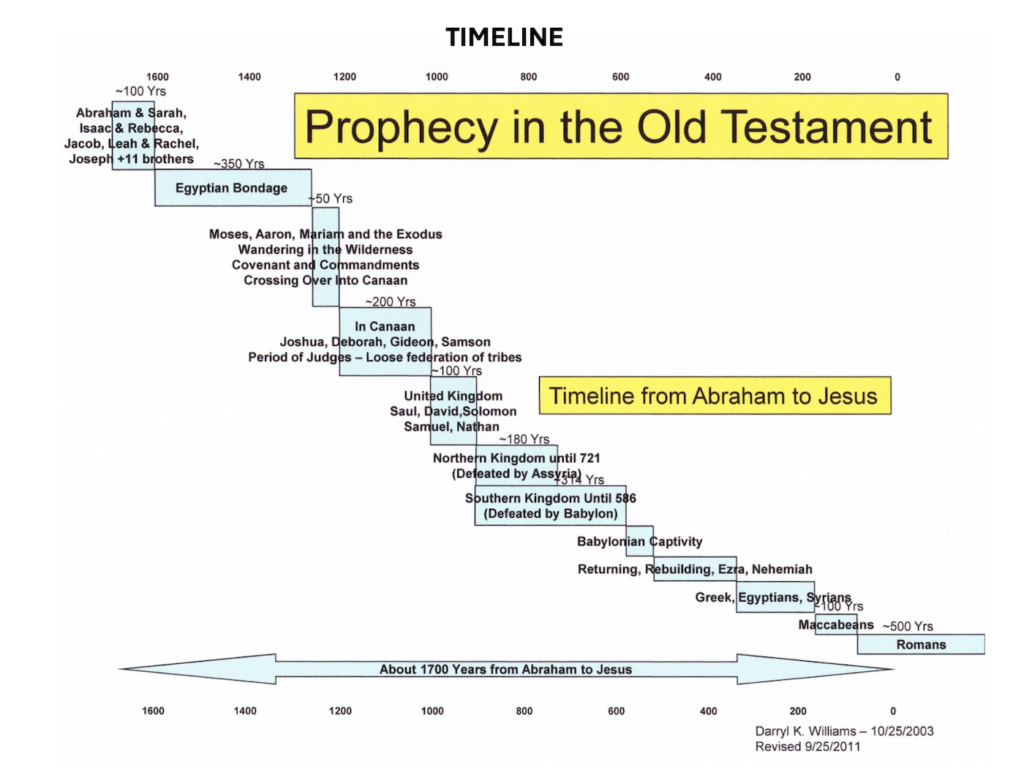
The background for all the charts is a timeline covering the approximately 1700 years from Abraham to Jesus.  There are various opinions among Bible scholars about some of these dates, but I had to choose something. The various prophets are shown in chronological order, which varies some from the order in the Bible. The charts also indicate whether  they prophesied in the Northern or Southern Kingdom, and before or after defeat and captivity.
 
If you took Dr. Luker’s course, or a similar one elsewhere, or if you just want to undertake your own study, these might be a helpful review or study/learning aid.  Probably the most shocking thing students learn from such a course is that the prophets were not primarily people who spent their time going around predicting the future but  were usually focusing their comments on the current situation and what it was likely to lead to if folks didn’t change their ways.  
 
Maximum upload size for the charts below is 1 MB so some may be difficult to read. At the bottom of the charts is a file that can be uploaded for better clarity.


And here is the downloadable file which may be easier to read and can be printed.

Old Testament Timeline – Abraham to Jesus

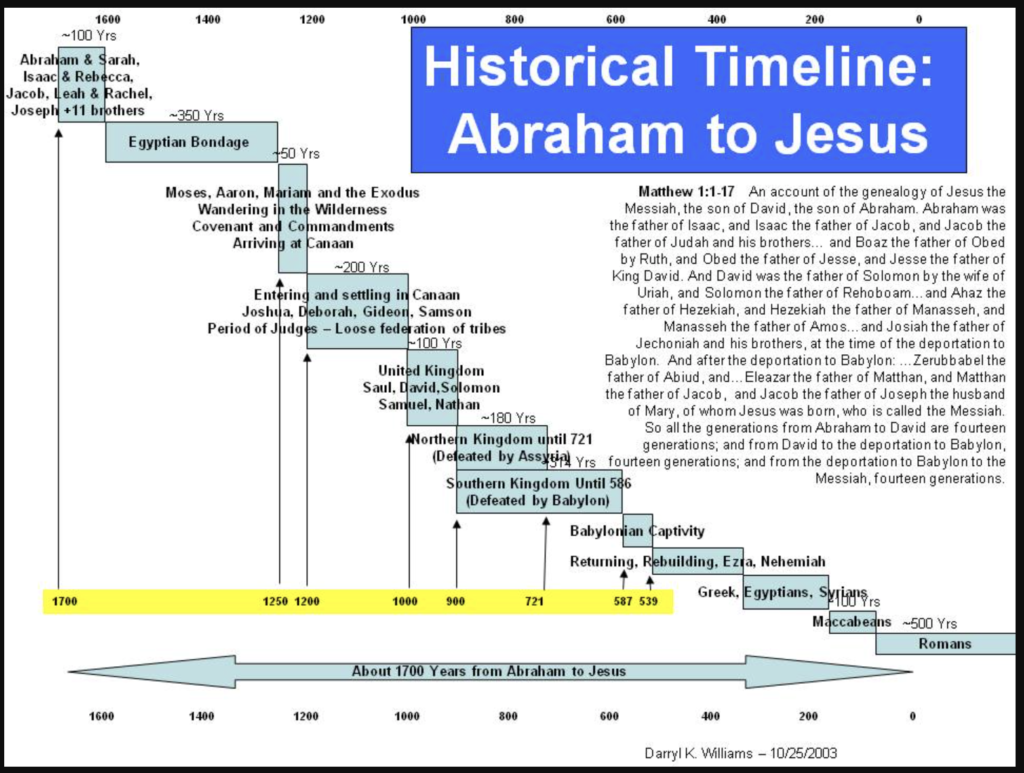
In Genesis 12:1, God told Abram to get up and go, and Abram, setting an example for us all, got up and went, taking his wife Sarai, his nephew Lot, and all their possessions, and headed for the land of Canaan. Abram, later to become Abraham, lived under a promise that God would bless him and make him a great nation and that through him all families of the earth would be blessed (Genesis 12:3). And that is the beginning, not of theological truth, but of history, in the Bible. And, while the story from that point on is historical, it is theological truth that dominates and is best served by the choices of people and events described and the words used to tell what happened. It is noted that not all Bible experts agree with these exact times and dates, but they are reasonable estimates.

The Old Testament story comes to life once the basic framework and timeline are in place and the people and events can be placed in proper context. It is for that reason that the timeline chart below was constructed by me, used in my OT study, and later in confirmation classes. Of course the greatest value is not in the use of such a device but in the construction of it. Nevertheless, here it is to use and/or improve as you see fit.  Click on it for a better view.

Kings, Kings, Kings – Turmoil in the Middle East

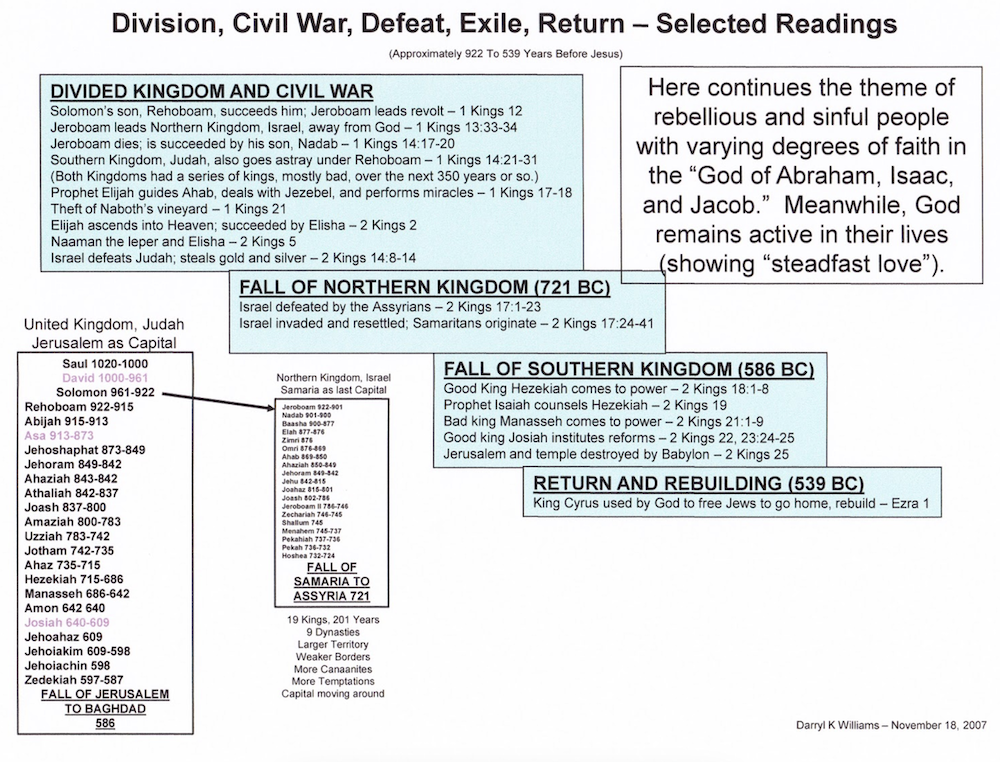
It is probably personal frustration with difficulty remembering details that drives my compulsion to gather and organize information visually, preferably on a single page. I did a lot of that during my three years at Lutheran Theological Southern Seminary. One topic I covered, superficially of course due to limited space, was Old Testament Kings of the Israelites.
 
The theme of kingship is an interesting one to follow through the Bible all the way from that first demand of the people for a king and Samuel’s warning about the problems that would cause to the arrival of the perfect but generally unrecognized and unacknowledged King of Kings, Jesus Christ.
 
The OT books of Samuel, Kings, and Chronicles include a wealth of stories about the roughly 600 years from the anointing of the first king, Saul, until the last of the people of Judah, the southern part of the divided kingdom, were defeated by King Nebuchadnezzar of Babylon and taken into captivity.  The diagram below was my attempt to organize the information in a way that would help me remember it.  Maybe you have a Sunday School class or a Confirmation class or other Bible study to lead and would find this helpful.  Feel free to use it and, if you find any mistakes, let me know.  I have a few more diagrams similar to this that I hate to throw away and will probably end up posting here.


Literary Structure in The Bible

With rapid expansion of digital communication, we may be losing the capability of constructing informative or inspiring sentences, punctuated and capitalized correctly, composed of carefully chosen and correctly spelled words, and arranged in logically organized and sequenced paragraphs. Apparently the ancient Greeks and Romans didn’t have those skills either, but they seem to have had something much more sophisticated. Take a look at this image of a Greek manuscript from Wikipedia.

Looks like Greek to me!  According to the Wikipedia article, this is the section of the New Testament we now label 2 Corinthians 11:33-12:9 (Chapter and verse designations were added only about 500 years ago.) Here it is in English, New Revised Standard Version, with all our normal grammatical helps removed and without the verse numbers.  Still looks like Greek.

but I was let down in a basket through a window in the wall and escaped from his hands it is necessary to boast nothing is to be gained by it but I will go on to visions and revelations of the Lord i know a person in Christ who fourteen years ago was caught up to the third heaven whether in the body or out of the body I do not know god knows and I know that such a person whether in the body or out of the body I do not know god knows was caught up into paradise and heard things that are not to be told that no mortal is permitted to repeat on behalf of such a one I will boast but on my own behalf I will not boast except of my weaknesses but if I wish to boast I will not be a fool for I will be speaking the truth but I refrain from it so that no one may think better of me than what is seen in me or heard from me even considering the exceptional character of the revelations therefore to keep me from being too elated a thorn was given me in the flesh a messenger of Satan to torment me to keep me from being too elated three times I appealed to the Lord about this that it would leave me but he said to me my grace is sufficient for you for power is made perfect in weakness so I will boast all the more gladly of my weaknesses so that the power of Christ may dwell in me

In my math and science oriented education, 1948-1964, I missed all study of classical languages.  Had I studied Latin, I would probably know all about chiastic structure or chiasms, but the first I ever heard of them was during Bible courses at Lutheran Theological Southern Seminary, 2002-2004.

Take a look at these links for a quick introduction or a refresher and some examples.

http://en.wikipedia.org/wiki/Chiastic_structure
http://en.wikipedia.org/wiki/Chiasmus
http://www.hccentral.com/gkeys/chiasm.html
http://www.wonderful1.com/Chiasms_in_the_Bible.html
http://www.bible-discernments.com/joshua/whatisachiasm.html

I played around a bit with the passage above from 2 Corinthians and believe I found a chiastic structure buried therein, in Chapter 12, verses 1-5 (Click for a better view, then “back.”:

So, what is the point?  Chiastic structures can be very helpful by pointing out where the writer intended to begin and end a sentence, a paragraph, or a longer passage.  “Boast” in the above section may be considered an inclusio, bracketing the section or perhaps paragraph.  So, whether it is important or not, I do not know, God knows, but it seems to me to be very useful in meditation on and study of Holy Scripture, searching for the deeper meanings.

During one seminary course, I wrote a paper on John 9, the story of the man born blind.  What a great story!  This narrative could be easily expanded into a screen play with interesting and complex characters and multiple underlying themes.  Here is an outline I prepared of the chiastic structure:

And here is the entire text organized in that same form.  I can’t claim the professor gave me a superb rating on this structure, but he didn’t declare it completely invalid either.  Read and enjoy! (Click for a more readable version, then “back.”:

Heresy!

An interesting way to view the history of The Church is through consideration of the struggle that has gone on through the centuries to understand and explain the unexplainable.  From a Catholic viewpoint, possible explanations that were rejected by the church carry the label, “heresy,” meaning that while we have no full and complete and correct explanations of God, those particular rejected explanations have been judged to be wrong.  I guess it is often easier to be clear about what does not work than about what does.  Here is a list with an approximate timeline of many of the heresies than have been identified.  Click on it for a readable version. The Nicene Creed, which addressed and rejected the major heresies of the time, originated at the Council of Nicaea in 325 and was amended at the First Council of Constantinople in 381.
 
If the above is difficult to read, try downloading the PDF version below. Feel free to use these but be sure to correct any errors before doing so!
 
First was the idea that one had to become a Jew (and be circumcised) before becoming a Christian.  That was rejected at the Council of Jerusalem about 15 years after the resurrection.  Then there were all those questions about Jesus.  Was he divine or human or both?  Was he prophet or savior?  Was he created by the Father, adopted by the Father, just one form of the Father, subordinate to the Father, or equal to and co-existent with the Father?  Did he have one nature or two, one will or two?  Did He come to save the whole world, or all people or just some people or just certain people?  Will he return physically or spiritually, now or later or never?  Did He just come to model the way he wants us to live, or did he establish a Church and leave people in charge of it.  Did he really die on the cross, or did somebody else take his place?
 
There were questions about God.  Is he involved continually with his creation or did he just set everything in motion at the creation and sit back to see what happens?  Was his creation evil or good or both?  How could he have created evil, and if he didn’t, what is the explanation for evil in the world?  Are there an evil god who created the earth and a good God, represented by Jesus, who rules the world to come?
 
What about the Church.  Is it just an invisible conglomeration of believers, or is it supposed to take up space and have a voice in the world.  Is it a democracy subject to the social pressures and whims of its members, or is there a teaching authority established by Jesus and handed down through the centuries to serve as a guide for society?  Does the Church do such things as baptism and communion just in obedience to and in memory of Jesus Christ, or is God truly present and primary in such actions?  Does the validity of such “sacraments,” if they are considered to be so, depend on the moral standing of the priest or pastor or only on the Grace of God?
 
And what about us and our salvation? Are we free and independent agents, choosing between good and evil, or are we totally dependent on God’s grace for anything good to happen.  Or maybe we just need a little nudge from the Almighty to get us headed in the right direction.  Or maybe our destinies have already been determined and we are just pawns.  Are we to read the Bible and interpret it as we see fit, or is there help or even some final word from the Church to assist or perhaps inform our understanding?
 
If you look through the subjects on the above chart, you will find references to all these questions.  And so far, the best statement we have of what we believe seems to be the Nicene Creed, finalized about 350 years after Christ and surviving now for more than 1600 years.    
 
Thanks be to God for the gift of The Church, The Body of Christ.

My primary sources for the information in the exhibit were Dissent from the Creed by Richard M. Hogan, The Story of Christianity by Justo L. Gonzalez, and www.newadvent.org.