16 Simon Peter answered, “You are the Messiah,[c] the Son of the living God.” 17 And Jesus answered him, “Blessed are you, Simon son of Jonah! For flesh and blood has not revealed this to you, but my Father in heaven. 18 And I tell you, you are Peter,[d] and on this rock[e] I will build my church, and the gates of Hades will not prevail against it. 19 I will give you the keys of the kingdom of heaven, and whatever you bind on earth will be bound in heaven, and whatever you loose on earth will be loosed in heaven.”
Matthew 16:16-19
20 “I ask not only on behalf of these, but also on behalf of those who will believe in me through their word, 21 that they may all be one. As you, Father, are in me and I am in you, may they also be in us,[f] so that the world may believe that you have sent me. 22 The glory that you have given me I have given them, so that they may be one, as we are one, 23 I in them and you in me, that they may become completely one, so that the world may know that you have sent me and have loved them even as you have loved me.
John 17:20-23
My Period of Innocent Ignorance
I graduated from Maryville High School, Maryville, Tennessee, in 1960. Latin was offered, but I took Spanish instead and remember nothing about that except that the name of the textbook was El Camino Real. Beginning in the 1960’s Latin was removed from the Tennessee public school curricula.
I was raised in the Southern Baptist Church, and our official church language in use was English. I remember knowing only one professing Catholic in our high school. It would have made sense for him to take Latin since all Catholic Masses had to be in Latin, and the official language of the Catholic Church was and still is Latin. I was unaware of the Catholic language issue and would have been unimpressed if I had been told about it. From my narrow and uninformed viewpoint at the time, I would have believed that the Catholic Church should be using English just like the Baptists.
I was so unaware of and uninterested in the Catholic Church in the 1960’s that I had little awareness of the Second Vatican Council which was underway 1962 to 1965. One of the momentous decisions made in that world-wide meeting of the Catholic Magisterium was that it would be OK for Catholic Mass to be celebrated in the local languages of the people as well as in Latin. I learned later that Catholic priest Martin Luther had proposed that about 500 years earlier to the deaf ears of Pope Leo X.
I wasn’t aware in the 1960’s that my Southern Baptist Church existed mostly in a few southern states with only a few million members while the Catholic Church was global with about 1.2 billion members. Because of that Catholic size and diversity, the change in Catholic rules meant that hundreds of teams could be put to work around the world translating the Mass from Latin to their own languages, hopefully without losing any of the deep historical and theological meanings of Latin.
My Period of Personal Enlightenment
Well, that is enough about my youthful ignorance and naivete. Jump forward to the early 21st century when I had spent decades as a Presbyterian and a Lutheran Christian and three years in a Lutheran seminary learning some basic Christian theology and history of the pre-reformation Christian Church, The Roman Catholic Church. Through travel, business experience, and living some different places, I had also learned a bit about the size and complexity and diversity of the world and the language issues that divide us.
I eventually concluded that Jesus had established a Church in the 1st century and left some people in charge and that it was very unlikely that he was satisfied with the Baptist or Presbyterian or Lutheran Church as the final product. I had no personal experience with the Episcopal Church but thought the Henry 8th involvement and British Monarch leadership of the Church of England pretty much ruled it out. It also seemed very unlikely that Jesus was happy with the mix of independent Churches with varying theologies and no common earthly leadership. I had no doubt that Jesus loved all those people trying to obey, please, and worship him but just didn’t believe they comprised the Church he established. It seems we have completely failed in living up to the hope of Jesus that we all be one.
That Church Jesus established is described in the 4th century Nicene Creed as “one holy, catholic, and apostolic.” I remember a Presbyterian pastor explaining that catholic in that case meant universal and was not a reference to the Roman Catholic Church. He didn’t realize that it was both.
I had become aware that the Protestant Reformation of the 1600’s was not a good thing and that the universal church of the time had to bear some responsibility for it. Jesus had promised that the gates of hell would not prevail against the church he established but had not promised the “gates” wouldn’t be around causing problems.
Official Language of the “one holy, catholic, and apostolic church”
The official language of the Christian Church for its first 400 years or so was Greek, same as for the Roman Empire of the time. The New Testament was written in Greek, and the Old Testament had been translated to Greek before Christ. (The Septuagint).
About 400 AD, the Roman Empire split into West and East, and the West adopted Latin as its official language. The Western Christian Church followed suit, and Pope Damasus I asked St. Jerome to translate the Bible into Latin. St. Jerome launched and led the project, and the translation was named The Vulgate. At the Council of Trent (1545-1563), The Vulgate was established as the authoritative biblical text of the Roman Catholic Church. The Eastern Church had stuck with Greek.
Now we are a quarter of the way through the 21st century and one big issue among Catholics, at least in America, is Latin. Some argue that Vatican 2 made a mistake and want to return to celebration only of the pre-Vatican Two Traditional Latin Mass. Some long for the day that we no longer use any Latin in the post-Vatican 2 Novus Ordo.
Some wonder why Latin is still the official language of the Church, but that is an entirely different issue from use of Latin in the Mass. I admit that I have often said that, without the Vatican 2 ruling, there is very little chance I would have wanted to be received into the Catholic Church in 2011. I have also said that the Latin Mass is not meaningful to me, and I would just as soon do without it while recognizing that there are still millions of Catholics who would just as soon do without the Mass in their own languages. And I used to wonder why Latin was still the official language at the Vatican.
My Current Thinking
So, after thinking the issues through, I have concluded that there are very good reasons for The Global Roman Catholic Church having a dead official language that is not the language of any segment of The Global Roman Catholic Church except the Vatican and is not subject to evolving meanings of words. I have also concluded that it would be beneficial for Catholics everywhere to be familiar with and able to understand and participate in the Novus Ordo Mass in Latin, especially when worshipping together with Catholics from other nations.
There is a website, Sancta Missa (Holy Mass) which explains the issues very clearly. These are its key points.
- The Universal Church should have a universal language, favoring no nation.
- Dead language words do not change in meaning. Doctrine is preserved.
- Latin is a sophisticated language suited for “the lofty nature of the liturgy.”
- Latin has been the official language of the Catholic Church for 2100 years.
- There is a large inventory of music for Latin Liturgy.
- Praying and singing in a single language is powerful and promotes unity.
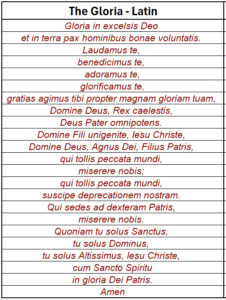
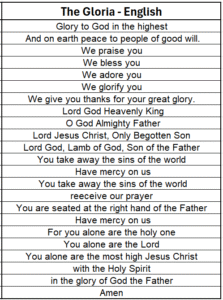
So, those of us who are not comfortable participating in the Novus Ordo (New Order) Mass with some Latin included should buckle down and learn it. If, like me, you need a little help, check out The Gloria in Latin and English at the chart below.
And for all Jesus loving baptized Christians who disagree with me and are unimpressed by my theological journey and the complicated and deep theology of the Catholic Church, be assured that the Catholic Church considers you to be “brothers and sisters in Christ” and hopes and prays that you have the same attitude toward Catholics.
From the Catechism of the Catholic Church – CCC–818 – “All who have been justified by faith in Baptism are incorporated into Christ; they therefore have a right to be called Christians, and with good reason are accepted as brothers in the Lord by the children of the Catholic Church.”
And here is that language aid mentioned above. The Gloria is a key part of the Catholic Mass.
Bonus: Here is a tongue in cheek piece I wrote 15 or so years ago, while still Lutheran, addressing the issue of so many Christian Churches. Big Methodists
This is the twelfth of my posts on Catholic theology and practice. For a list of all posts, go HERE.